Learning Center
A plain-English guide to how foreclosure actually works — the national picture, how the process differs state by state, the marketing laws you have to follow when you reach out to a distressed owner, and who runs the sales. This is the education. The tool lives here.
Foreclosure activity has been climbing after years of pandemic-era moratoriums and forbearance. Here's where the U.S. stood at the mid-point of 2026, per ATTOM's U.S. Foreclosure Market Report — the industry-standard, publicly published source.
Biggest year-over-year jumps in filings:
Largest share of homes in foreclosure:
Every state runs foreclosure one of two ways — through a courtroom, or through a trustee. Which one your state uses drives the entire timeline, the paperwork, and how much runway a homeowner has.
The lender files a lawsuit and a judge signs off on the sale. It's slower — often 6–12 months or much longer if contested — and usually ends in a sheriff's sale. Many judicial states also give the owner a post-sale redemption period to buy the home back.
No courtroom. A trustee named in the deed of trust sells the property under a "power of sale" clause after a required notice period. Much faster — typically 2–6 months from the notice of default to the auction on the courthouse steps.
The core rules for the markets we cover. Timelines are typical ranges, not guarantees — every case turns on the specific notice, the lender, and the county. Always verify the current dates on the recorded Notice of Default / Notice of Trustee's Sale.
A 3-month reinstatement window runs from the recorded Notice of Default — a key cure period to work with the owner.
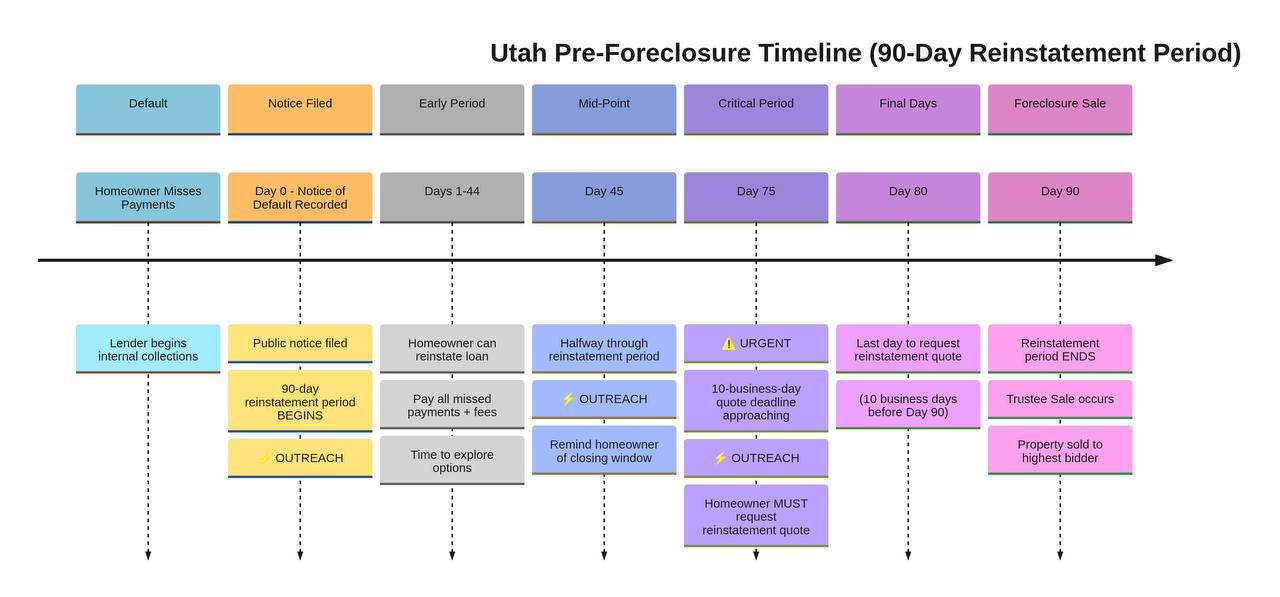 Tap to open the full Utah timeline
One of the fastest-heating markets in the country (+59% YoY). The 120-day notice gives a real cure/negotiation runway.
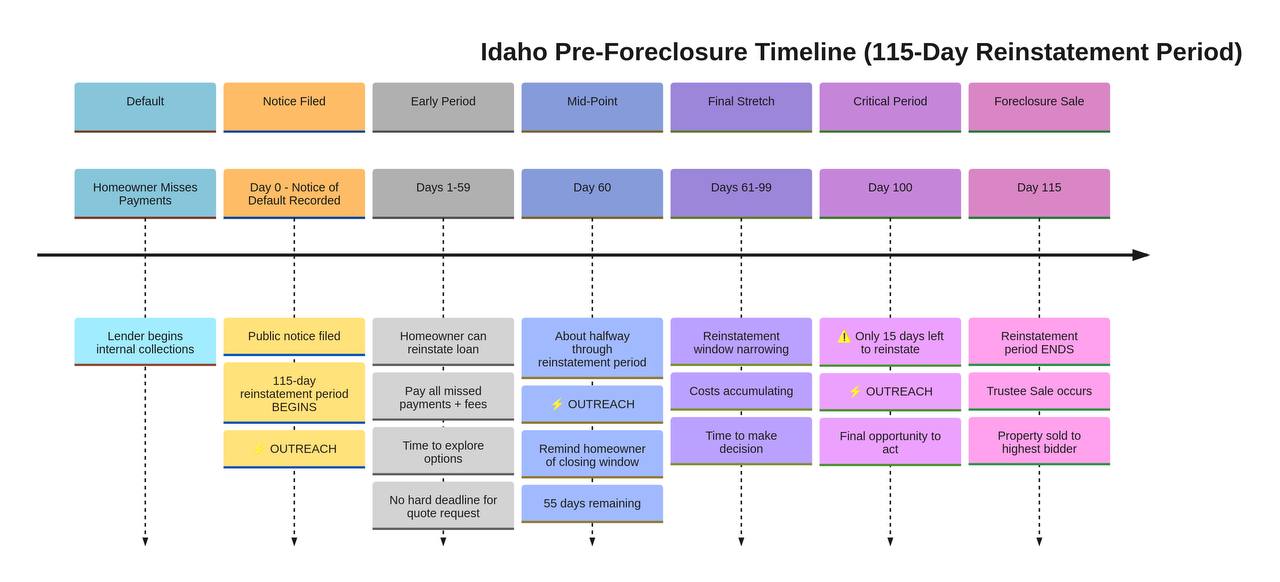 Tap to open the full Idaho timeline
Larger acreage or non-STFA loans can be judicial, which adds a redemption period — check the deed of trust.
The 90-day statutory notice is the reinstatement window — the owner can cure up until shortly before the sale.
Nevada has some of the strictest notice + mediation rules in the West — respect every required disclosure.
Fastest-rising rate among big markets (+57% YoY). Colorado also has a strong Foreclosure Protection Act — see marketing laws below.
Heavily regulated for investors: WA's Distressed Property Law (RCW 61.34) and equity-skimming rules are among the strictest in the U.S. — read the marketing section carefully.
The primary foreclosure method, a typical timeline, and whether the owner gets a post-sale redemption period. Filter by process type below.
Reaching out to someone in foreclosure is regulated in most states. A whole category of law — "foreclosure consultant" and "equity purchaser" statutes — exists specifically to protect distressed homeowners from being taken advantage of. If you contact, consult, or buy from an owner in default, these can apply to you. Know them before you send a single letter.
Many states (CA, CO, MN, MD, NY, WA and others) regulate anyone who, for compensation, offers to help an owner stop or postpone a foreclosure. Typical rules: a written contract, mandatory statutory notices, a right to cancel (often 3–5 days), and a ban on collecting fees up front.
"Equity purchaser" / "distressed home purchaser" acts govern buying a residence that's already in foreclosure. They commonly require specific written disclosures (your name/address, the full legal description, the terms), a homeowner right of rescission measured from recording, and bans on unconscionable terms or deed-for-lease "sale-leaseback" traps.
Washington's Distressed Property / equity-skimming law is broad and aggressive. "Foreclosure rescue" and finance-back schemes that let a seller stay in the home are effectively prohibited — this is the classic "foreclosure bailout is illegal in WA" rule. Tread very carefully.
Colorado's Act regulates both foreclosure consultants and equity purchasers, with required contract language, cancellation rights, and conduct standards. A leading example of a state that layers both regimes together.
Effective August 28, 2026, Missouri requires "we buy houses" wholesalers to disclose to sellers that they're a wholesaler and to encourage sellers to seek legal, tax, and real-estate advice before signing — part of a growing national trend toward wholesaler transparency.
On top of the specialty statutes: federal telemarketing / DNC rules, TCPA on texts and autodialed calls, truth-in-advertising, and state real-estate licensing lines. "Skip-traced and legal to call" are two different questions — honor DNC status and consent.
In non-judicial states the sale is run by a trustee — usually a specialized law firm named on the recorded Notice of Trustee's Sale. Knowing the big regional players tells you where to find the official sale lists, opening bids, and postponements. These are commonly-seen foreclosure trustees across the Mountain West; always confirm the trustee named on the specific recorded notice.
UT · ID · MT · WY · CO · and 15+ more states
One of the largest multi-state foreclosure trustees in our footprint. Handles trustee sales, bankruptcy, evictions, and REO closings — a primary source for Mountain West sale lists.
ID · UT · multi-state
A large national mortgage-default and foreclosure trustee frequently named on Western trustee sales.
UT
In Utah, title and trustee companies also run sales and publish opening bids — a key ground-truth source for the posted bid.
Every state
The real source of truth is the recorded notice and the trustee's published sale list — that's where the actual sale date and opening bid live. OffRamp verifies against these directly.
You understand the process — OffRamp puts the verified, skip-traced leads in front of you.
See live deals in your market → OffRamp